
Half the SEO proposals we review are selling the wrong product. A Jacksonville plumber gets pitched blog content and link building, while an e-commerce store gets pitched citation cleanup. Understanding local SEO vs traditional SEO is how you avoid paying for the wrong one, because they are two different systems with two different scoreboards.
We are Grindstone Design, a web design and SEO agency in Jacksonville that works with service businesses across Florida and Georgia. This guide explains both systems in plain terms, then gives you a decision framework by business type. By the end you will know exactly which line items belong in your proposal.
What Is Local SEO?
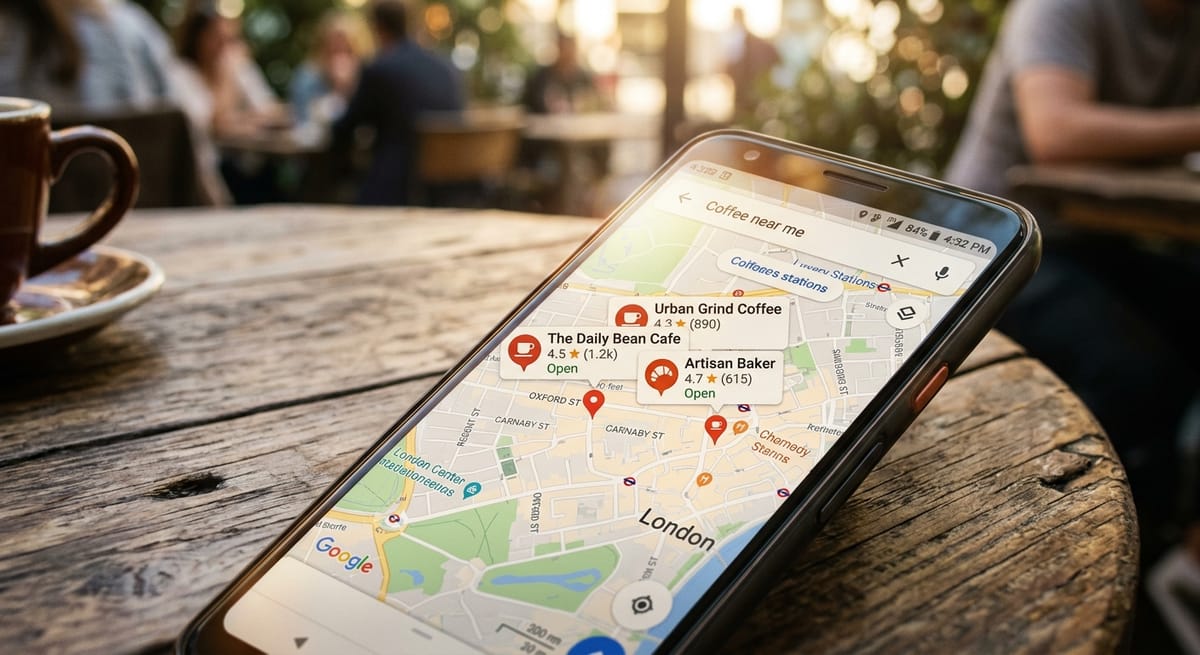
Local SEO is the work of ranking in Google's map pack, the block of three business listings with a map that appears for searches like "plumber near me" or "Mexican restaurant Jacksonville." That block sits above the regular results on most local searches, and on mobile it fills the entire first screen.
The map pack runs on different inputs than regular rankings. Google has published its three local factors, which are relevance, distance, and prominence. In practice that means your Google Business Profile, your reviews, your citations across directories, and your proximity to the searcher decide most of the outcome.
Your website still matters for local, but as a supporting signal rather than the main event. A well-built city page and service pages feed relevance into your profile. We broke down the revenue side of this in our post on how local SEO impacts your business, and the short version is that map pack clicks convert fast because the searcher is usually ready to call.
What Is Traditional SEO?
Traditional SEO, sometimes called organic SEO, is the work of ranking your website's pages in the regular blue-link results. The inputs are your site's content, its technical health, and the links pointing at it from other sites. Distance plays no part, which is why a Wisconsin blog can outrank a Florida one for a national query.
The work looks like keyword research, publishing pages that answer what people search, fixing crawl and speed issues, and earning links. Results compound slowly. A page published today typically needs 3 to 9 months to reach its ranking ceiling, and competitive terms take longer.
Traditional SEO is the right tool when your customers are everywhere. An online store shipping nationwide, a SaaS product, or a course business all live or die on organic rankings and have no map pack to win. It is also the tool for capturing research-stage searches, like "how much does a kitchen remodel cost," which local profiles never rank for.
Local SEO vs Traditional SEO: What Is the Real Difference?
The clearest way to see the difference is tactic by tactic. Here is what each system actually rewards, and who needs which.
| Tactic | Local SEO | Traditional SEO | Who needs it |
|---|---|---|---|
| Google Business Profile optimization | Core | Irrelevant | Any business serving a geographic area |
| Review generation | Core ranking and conversion factor | Indirect trust signal | Local service businesses, restaurants, medical |
| Citations (directory listings) | Supporting factor | Negligible | Local businesses, especially new ones |
| Keyword-targeted service pages | Supporting | Core | Everyone with a website |
| Blog content | Minor | Core | E-commerce, B2B, anyone chasing research queries |
| Link building | Prominence signal | Core | Competitive markets, national businesses |
| Technical site health | Supporting | Core | Everyone |
| City and service-area pages | Core | Core for regional terms | Multi-city service businesses |
| Proximity to searcher | Decides a lot, can't be bought | Irrelevant | Nobody controls it, everybody feels it |
Notice the overlap rows. Service pages and technical health feed both systems, which is why a bad website drags down even a great Google Business Profile. The systems are separate, but they share a foundation.
Which One Does Your Business Actually Need?
Match the strategy to how your customers buy, because the answer differs by business model. Here is the framework we use with prospects.
A plumber, roofer, HVAC company, or electrician needs local first. Your buyers search with urgency and pick from the map pack, so Google Business Profile work, reviews, and city pages come before any blog post. Put 80 percent of the budget there for the first year.
An e-commerce store needs traditional only, unless it has a physical showroom. There is no map pack for "walnut cutting board." Your budget goes to product page SEO, content, and links.
A restaurant needs local plus a relentless review pipeline. Discovery happens in the map pack and on the profile itself, through photos, menu links, and review replies. A blog is close to worthless here.
A regional B2B company, like a commercial contractor serving Florida and Georgia, needs both. Procurement teams research through organic results, while owners and facility managers search locally. Split the budget and expect the organic half to take longer. If you are still deciding whether any of this pencils out for your size of business, our post on whether SEO is worth it for small businesses runs the actual math.
What Does Local SEO Work Look Like Month to Month?
Owners ask us this constantly, usually after paying another agency $500 a month for something invisible. Legitimate local SEO has a recurring task list you can inspect.
In a typical month, that list includes review generation and responses, Google Business Profile posts and photo uploads, Q&A monitoring, and citation checks for consistency across directories. On the website side it includes building or improving one to two location or service pages and tightening internal links. Reporting should show calls, direction requests, and website clicks from the profile dashboard, along with map pack positions tracked from several points around your service area.
Some months also include spam fighting, which means reporting fake competitor listings and review attacks. In crowded trades like locksmiths and garage door repair, this alone can move rankings, because Google removes competitors that should never have ranked.
Local retainers for a single-location business typically run $500 to $2,000 per month depending on market competition. Our full breakdown of how much SEO costs in 2026 covers what separates the $500 tier from the $2,000 tier. If a proposal cannot name the monthly tasks, the price does not matter.
Not sure what you are currently paying for? Request a free business audit from Grindstone Design and we will show you what has actually been done on your profile and site.
Why Does Review Velocity Beat Review Count?
A business with 400 reviews and 2 new ones per year loses ground to a business with 150 reviews and 10 new ones per month. Google's own documentation confirms that review count and score factor into local ranking, but the pattern we see across client dashboards is that steady incoming reviews move rankings more than a big static total.
The logic holds from Google's side. A stream of fresh reviews is ongoing evidence that a business is open, active, and serving people this month. A pile of old reviews proves the business was good in 2022.
Customers read it the same way. Most people sort by newest, 74% of consumers in BrightLocal's review survey look for reviews from the last three months, and a three-month gap reads as decline even when nothing changed. That is why the core review tactic is a system. Every completed job triggers a review request by text within 24 hours, when the customer is happiest.
Two practical rules. Never buy reviews, since Google filters them and the FTC's rule banning fake reviews now puts civil penalties behind them. And reply to every review, because replies are visible effort on the one page every prospect checks.
Do Service-Area Businesses Play by Different Rules?
Yes, and this trips up contractors constantly. Google splits local businesses into storefronts, where customers come to you, and service-area businesses, where you go to customers. A service-area business must hide its address on its Google Business Profile if it works from home, and it competes in the map pack across its declared service area.
The catch is that ranking strength decays with distance from wherever your business is actually based. A Jacksonville Beach remodeler will struggle to crack the map pack in Orange Park no matter how good the profile is. Proximity cannot be optimized away.
The workaround is on the website side. City pages, one per market with genuinely local content like completed projects and local reviews, can rank in the organic results for "remodeler orange park" even when the map pack stays out of reach. This is the overlap zone where local SEO services and traditional page-building blend into one strategy. We build these for clients across the metros on our service area list, and the city page plus profile combination is what makes multi-city coverage work.
Can You Run Both on a Small Budget?
Yes, if you sequence instead of splitting. A $1,000 monthly budget spread evenly across both systems moves neither. The same budget pointed at one system for six months produces rankings you keep.
For most local service businesses the sequence is fixed. Months 1 through 6 go to the Google Business Profile, the review system, and the core service pages. Months 7 and onward shift budget toward organic. That means city pages for neighboring markets and content for the research queries your buyers type before they know your name.
The order flips for businesses whose revenue is mostly outside their metro. A Savannah manufacturer selling statewide should build organic first and treat the local profile as a maintenance item. The test is simple. Look at your last 20 customers and count how many could have found you in a map pack, then fund whichever system matches the majority.
How Are AI Overviews Changing Local Search in 2026?
Google's AI Overviews, the AI-written answer box that launched broadly in 2024, now appear on a large share of informational searches. For local intent, the picture is more stable than the panic suggests. Searches like "emergency plumber jacksonville" still resolve to the map pack, because Google makes money and keeps users happy by showing businesses, and an AI paragraph cannot unclog a drain.
What has changed is the research phase. Queries like "best CRM for roofers" or "how to choose a med spa" now often get an AI Overview that names specific businesses and cites specific pages. The sources those answers pull from are the same things good SEO already builds. Those are clear service pages, real reviews, and consistent business information across the web.
ChatGPT and other assistants pull local business data too, largely from the same public sources plus mapping data. Our practical guidance for 2026 is unglamorous. Keep the Google Business Profile complete and active, publish pages that answer buying questions in plain language, and hold review momentum. Businesses with thin profiles and vague websites are the ones AI answers skip.
There is one honest unknown worth stating. Nobody, including Google, has published reliable click-through data for local queries with AI Overviews present. Treat any agency claiming certainty here as a red flag.
FAQ
Can I do local SEO myself?
The foundations, yes. Claim and complete your Google Business Profile, add photos monthly, ask every customer for a review, and keep your name, address, and phone identical everywhere. That is several hours a month and beats what many cheap agencies deliver. Where owners hit a wall is city page creation, technical fixes, and competitive markets where every rival is also doing the basics.
How long does local SEO take to show results?
Faster than traditional SEO in most markets. Profile optimization and review momentum can move map pack rankings in 30 to 90 days, especially for businesses that were poorly set up before. Competitive metro markets like Miami or Atlanta take longer, often 4 to 8 months for meaningful placement. Website-side work like city pages follows the slower organic timeline of 3 to 9 months.
Do I need a website if my Google Business Profile ranks well?
You need one, and a real one. Google uses your website as a relevance signal for the profile, so a thin one-page site limits your map pack ceiling. More practically, most searchers click through to the site before calling, and a dated site kills the lead the profile earned. The profile wins the ranking, the website wins the customer.
Is local SEO cheaper than traditional SEO?
Usually, yes. Single-location local campaigns run $500 to $2,000 per month, while serious traditional SEO campaigns typically start around $1,500 and climb past $5,000 in competitive niches. The gap exists because local work has a bounded task list while organic work requires ongoing content and link acquisition. Multi-location local campaigns close the gap fast, since each location multiplies the work.
What is a citation and do citations still matter?
A citation is any listing of your business name, address, and phone number on another site, like Yelp, Angi, or a chamber of commerce directory. They matter as a trust foundation, and inconsistent ones actively hurt. The work is front-loaded. That means a cleanup and 30 to 50 core listings early on, then light maintenance. Monthly citation building as an ongoing line item is usually padding.


