Website Redesign Cost in 2026

Most small business website redesigns in 2026 cost between $3,000 and $15,000. A light cosmetic refresh can come in under $5,000. A full rebuild with a platform change and an SEO migration can pass $30,000, and large e-commerce replatforms go well beyond that.
Website redesign cost depends almost entirely on scope, and most pricing articles never define scope. This guide does. It also covers the parts agencies rarely write down. Payment structures, the tax question, protecting your rankings, and how to get quotes you can actually compare.
We're Grindstone Design, a web design and SEO agency in Jacksonville, Florida. We've redesigned sites for restaurants, contractors, golf brands, and e-commerce stores across Florida and Georgia. The numbers below mix published market rates with what we see on real projects, and we'll tell you which is which.

The honest answer is a table, because a $2,000 refresh and a $40,000 replatform are different products that happen to share a name. Figure out which row you're in before you request a single quote. Half the sticker shock in this industry comes from owners pricing row one while agencies quote row three.
| Redesign scope | What you get | Typical 2026 cost | Typical timeline |
|---|---|---|---|
| Cosmetic refresh | New colors, fonts, imagery, and homepage layout on your existing platform. Same pages, same content. | $1,500 to $5,000 | 2 to 4 weeks |
| Full redesign, same platform | New design system, restructured navigation, rewritten core pages, updated plugins and forms. | $5,000 to $15,000 | 6 to 10 weeks |
| Rebuild and replatform | New platform, new design, full content migration, 301 redirect map, new copywriting. | $10,000 to $35,000 | 8 to 14 weeks |
| E-commerce replatform | Product and customer data migration, payment and shipping setup, URL mapping for hundreds of pages. | $15,000 to $75,000+ | 10 to 16+ weeks |
For a market reference point, WebFX publishes professional web design pricing of $6,500 to $15,000 for a basic business site, with enterprise projects passing $100,000, which skews toward larger companies. Freelancer platforms quote far less, often $1,000 to $5,000, with a much wider range in quality. Small business agencies live between those two poles.
Location barely moves these numbers anymore. A Jacksonville contractor and an Atlanta med spa will get quotes in the same ranges, because most agencies work remotely and price by scope. What does vary locally is demand for specific niches, so a Miami restaurant redesign with online ordering will price closer to e-commerce than to a brochure site.
If a quote comes back far under $2,000 for anything beyond a cosmetic refresh, ask what got cut. Something did.
Redesign pricing tracks new-build pricing closely, so if you want the full breakdown of line items, our guide to how much a website costs in 2026 walks through every one.

Within each tier, six variables move the number more than anything else. Knowing them lets you trade scope for budget on purpose instead of by accident.
Page count is first. A 12-page site and a 90-page site can share a design, but every page still needs migration, formatting, and QA. Copywriting is second, and it's the quiet one. Agency-written copy adds $100 to $300 per page, while client-written copy is free and late, which we'll get to.
Custom features are third. A gallery and a contact form cost nothing extra in 2026. Online ordering, customer portals, booking systems, and quote calculators each add $1,000 to $10,000 depending on complexity. Integrations are fourth, and each CRM, scheduling tool, or inventory sync you keep adds hours of setup and testing.
The last two are photography and stakeholders. Stock photos are cheap and look it, while a half-day local shoot runs $500 to $1,500 and changes how the whole site reads. And every additional decision-maker on your side adds roughly a week of revision time, so pick one owner for the project before you pick an agency.
Cutting cost works best in this order. Trim page count first, write your own copy second, defer custom features to phase two third. Cutting the SEO migration to save money is the one move that reliably costs more than it saves.
Keep your existing site's bones when the platform is modern, the page structure works, and the problem is mostly visual or conversion related. In that case you're buying a redesign, and you should pay redesign-tier prices. We published 10 signs your website needs a redesign if you want the full diagnostic.
Start over when the platform itself is the problem. That means an abandoned page builder, a theme nobody can edit safely, a site that was never structured for search, or mobile layouts that break on half your traffic. Patching a bad foundation costs more than replacing it, usually within 18 months.
There's a quick gut check we give owners on calls. If you'd keep more than half your current pages and copy as-is, it's a redesign. If you're embarrassed to send the link to a prospect, it's probably a rebuild, and our list of 12 warning signs your site looks outdated will tell you which kind of embarrassed you are.
One real example from our own work. Rex Golf came to us with a site that undersold the product, and the fix was a full redesign rather than a patch. The Rex Golf website redesign case study shows what that scope looked like in practice.
If you're on the fence, this table maps the common situations we see on audit calls.
| Your situation | Redesign or rebuild? | Why |
|---|---|---|
| Site converts poorly but loads fast on a modern platform | Redesign | The foundation is fine, the presentation isn't |
| WordPress site on a heavily customized 2017 theme | Rebuild | Old themes fight every change and break on updates |
| Wix or Squarespace site that's outgrown the platform | Rebuild and replatform | You can't patch your way past platform limits |
| Rankings are strong, design is dated | Careful redesign | Preserve URLs and structure, change the skin |
| No rankings, no traffic, 8-year-old site | Rebuild | There's nothing to preserve, so start clean |

Owners assume a redesign should be cheaper than a new site because "half the work is done." Agencies quote the opposite, and here's why.
Content migration is manual labor. A 60-page site at 20 to 45 minutes per page is 20 to 45 hours of moving, reformatting, and checking content before any design work matters. Blogs with hundreds of posts multiply that fast.
E-commerce adds product data, customer accounts, and order history, which is why the Wood Pro Supply Shopify replatform was scoped as a migration project first and a design project second. That project cut cart abandonment 40% and lifted mobile revenue 85%, and none of it happens without clean migration.
SEO preservation is the second cost. A new site has no rankings to lose. Your current site has 5, 10, maybe 15 years of accumulated URLs, backlinks, and rankings, and protecting them takes a full crawl, a redirect map, and post-launch testing. Budget 10 to 25 hours for this on a mid-sized site.
Technical debt is the third. Undocumented plugins, hardcoded phone numbers, forms wired to an email nobody checks. Every old site hides surprises, and experienced agencies price for them.
Not sure which scope you actually need? Our free business audit reviews your current site's traffic, speed, and structure and tells you whether a refresh or a rebuild makes sense, with no obligation attached.
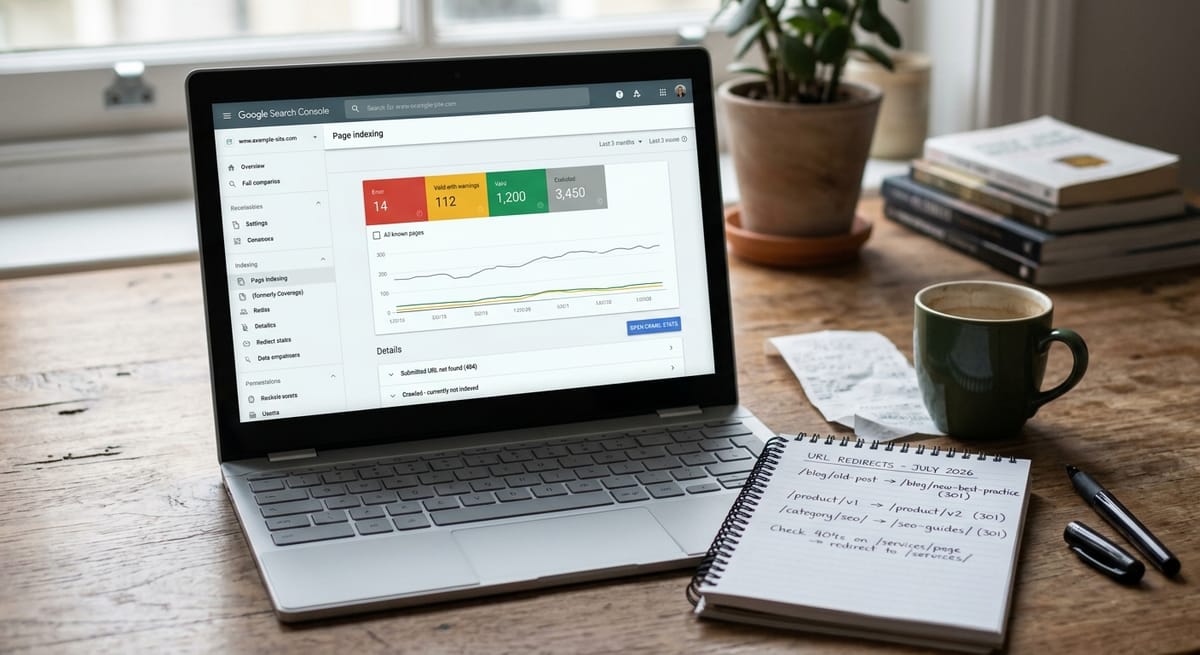
This section matters more than the price. A redesign that saves you $3,000 and loses your rankings is the most expensive option on the table.
Four rules cover most of it. Keep your URL structure identical wherever possible, because a URL that doesn't change needs no redirect. Build a one-to-one 301 redirect map for every URL that does change, never a blanket redirect to the homepage.
Benchmark your rankings and top landing pages before launch so you can spot damage within days. Then crawl the new site the week it goes live and fix broken links and missing pages immediately.
Now the traffic dip question, because you'll hear two versions. The myth is that any redesign tanks your traffic for months and there's nothing you can do. The reality is that a small dip for 2 to 6 weeks while Google recrawls the new site is normal and recovers on its own. A sustained drop of 30% or more is a botched migration, usually missing redirects or deleted pages, and it's fixable if caught fast.
For launch week itself, this is the short checklist we run on every project.
A redesign is also the cheapest moment you'll ever have to fix page speed, since the developer is already in the code. Hand them the targets from our website speed optimization guide and make passing Core Web Vitals a launch requirement, in writing.
You'll run into three common structures, and each has a catch worth knowing before you sign.
| Payment structure | How it typically works | What to watch |
|---|---|---|
| Deposit plus balance | 40-50% up front, remainder at launch | Define "launch" in the contract, or a delayed launch delays nothing but your invoice |
| Milestone payments | 3 or 4 payments tied to design approval, staging build, and go-live | Make approval criteria specific, vague milestones cause vague disputes |
| Monthly plan | $300 to $1,000 per month over 12 to 36 months, often bundled with hosting | Confirm in writing who owns the site and domain if you stop paying |
The monthly plan deserves the hardest look. Some are honest financing. Others are rental schemes where the agency owns your site forever and cancellation means starting from zero. Ask one question, "if I cancel after month 14, what do I walk away with?" A good agency answers in one sentence.
Deposits of 40 to 50% are standard and fair, since the agency does most of its work before launch. A demand for 100% up front from an agency you've never worked with is a red flag at any price.
Yes, and for tight budgets it's often the smart play. A phased redesign ships the highest-impact pages first, usually the homepage, your top 3 service pages, and the contact flow, then migrates the rest over 2 or 3 months.
Phasing spreads cost without the ownership risks of a rental plan. It also gets your best pages earning sooner. The homepage that converts at 4% starts working in week 6 instead of week 14.
The tradeoff is a few months of visual mismatch between new and old pages, plus some duplicated QA. On sites over 100 pages we think the tradeoff is usually worth it. On a 10-page site, just do it all at once, the savings aren't real at that size.
Generally, yes. Business website costs are deductible business expenses in the US. Depending on how the work is classified, your accountant may deduct the full amount in the year you pay or spread it over several years, since some website work gets treated like software development and some like advertising.
The distinction can shift your real out-of-pocket cost by thousands of dollars, so raise it before the project starts. Treat this as a reminder to ask your CPA, since tax advice from a web designer is worth what you paid for it.
Three quotes for "a website redesign" will span $4,000 to $40,000, and none of them will be wrong. They're pricing three different projects. Send every agency the same one-page brief and the spread collapses to something you can actually compare.
Put these eight things in it.
The SEO line is the one most owners skip and most cheap quotes silently exclude. Putting it in the brief forces every bidder to price it, which is exactly the point.
When you're ready for a real number instead of a range, request a redesign quote and include the brief above. We'll come back with a fixed, scoped price within a few business days, and we'll tell you if a cheaper tier would honestly do the job.
Most small business redesigns run $3,000 to $15,000 in 2026. A cosmetic refresh on your existing platform costs $1,500 to $5,000, while a full rebuild with a platform change runs $10,000 to $35,000. E-commerce migrations cost more because product data, customer accounts, and hundreds of URLs have to move cleanly.
Only if the migration is done badly. A dip of a few weeks while Google recrawls the new site is normal and recovers. Lasting damage comes from missing 301 redirects, deleted pages, and changed URLs with no map. Require a one-to-one redirect plan as a written deliverable and benchmark your rankings before launch.
Every 3 to 5 years is the common pattern, but the calendar matters less than the numbers. Redesign when conversion rates slide, mobile experience breaks, load times pass 3 seconds, or the platform stops getting updates. A site that still converts well at year 6 doesn't need a redesign because of its age.
Yes, many agencies offer plans from roughly $300 to $1,000 per month over 1 to 3 years, often bundled with hosting and maintenance. Before signing, get written confirmation of who owns the site, domain, and content if you cancel. Honest financing transfers ownership to you. Rental schemes never do.
A cosmetic refresh takes 2 to 4 weeks. A full small business redesign takes 6 to 10 weeks, and a replatform runs 8 to 16 weeks depending on content volume. The biggest schedule variable is how fast you deliver content and feedback, not how fast the agency designs.
Discover more insights from our latest articles


