What a Small Business Website Actually Includes at Each Price

Most website proposals hide the answer to the only question that matters. What does a website include for the money you are about to spend? A $4,000 quote can mean 12 hours of template work or 80 hours of custom design, and the proposal often reads the same either way.
We run Grindstone Design in Jacksonville, and prospects bring us competitor proposals every month. The vague ones far outnumber the clear ones. This post itemizes what you actually get at three real budget tiers, so you can put two proposals side by side and see which one is thin.
If you want the full pricing picture first, read our breakdown of how much a website costs in 2026. This post assumes you know the ranges and want to know what is inside them.

Small business website pricing clusters into three bands. Roughly $1,000 to $3,000 for template work, $5,000 to $10,000 for semi-custom builds, and $15,000 and up for fully custom projects. WebFX pegs basic professional web design at $6,500 to $15,000, which overlaps the second and third tiers.
You will see quotes in the gaps, like $4,200 or $12,000. Those are usually one tier's process with an extra deliverable bolted on, like copywriting added to a template build. The tier logic still applies, so figure out which base process you are buying.
One note before the teardown. These numbers are for new builds. Rebuilding an existing site carries extra work like content migration and redirect mapping, and we priced that separately in our website redesign cost guide.

At this tier you are buying a customized template, usually on WordPress, Squarespace, or Wix. The designer picks a pre-built theme, swaps in your logo and colors, and loads your content into it. Expect 5 to 7 pages that share one or two layouts.
Here is the honest inclusion list at this price. You write the copy yourself, or the designer pastes in whatever you send. Photos come from your phone or a stock library. The contact form is the standard one that ships with the theme.
SEO at this tier means the theme loads without errors and the designer fills in page titles. There is no keyword research, no content strategy, and usually no Google Search Console setup. Speed work does not happen, so you get whatever performance the theme ships with.
Revisions are typically one round. Training is a screen recording if you are lucky. Support after launch is often 14 to 30 days of bug fixes, then hourly billing. None of that is a scam, it is just what $2,000 buys, and for a brand-new business it can be the right call.

This is where design becomes actual design. You should get 3 to 5 unique page layouts built for your business, meaning the homepage, a service page template, and the contact page each get their own composition. Interior pages reuse those layouts.
Copywriting enters the picture here, at least partially. Many agencies include copy for the homepage and core service pages, then template the rest. Ask exactly which pages get written copy, because "we polish your content" means you are still the writer.
On-page SEO becomes real at this tier. That should mean keyword research, a page-by-page keyword map, written title tags and meta descriptions, header structure, internal links, and Google Analytics plus Search Console configured before launch. A speed pass belongs here too, with the site tested against Core Web Vitals on mobile.
Expect 2 to 3 revision rounds, a one-hour training call, and a 30 to 90 day warranty on bugs. Integrations like a booking tool, a CRM connection, or online ordering usually fit in this budget. If a proposal at $7,000 includes none of the SEO items above, you are paying tier-two money for tier-one work.
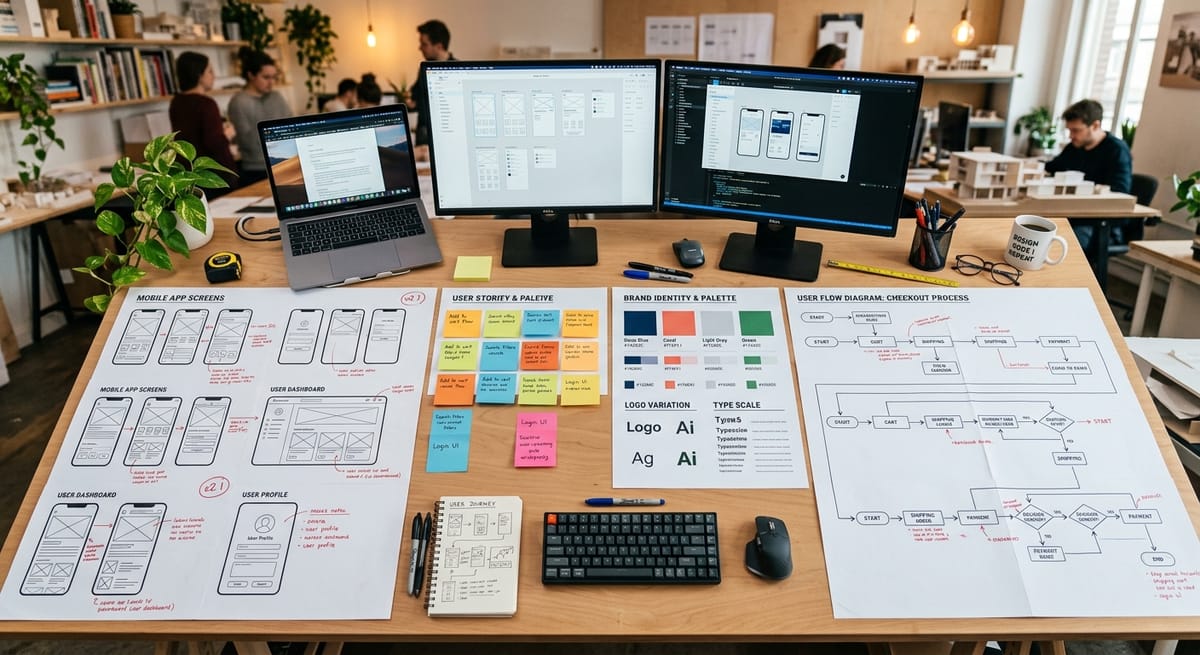
Fully custom projects start with strategy, and that is the real difference. Before anyone designs a pixel, you should get a discovery phase covering your customers, your competitors, and the actions the site must drive. The design is then built around conversion paths instead of around a theme's existing sections.
Deliverables typically include 6 to 12 unique page designs, full copywriting for every page, custom photography direction or a shoot, and custom functionality. That functionality is where budgets climb, things like quote builders, customer portals, e-commerce with complex product logic, or RFQ systems for B2B catalogs.
Technical SEO gets deeper. Schema markup, a full redirect map if you are migrating, crawl testing, and Core Web Vitals targets written into the contract rather than implied. Post-launch support often runs 3 to 12 months with defined response times.
Builds at this level take 10 to 16 weeks. Our guide on how long it takes to build a website maps each phase week by week, and the pattern holds at every tier.
| Deliverable | $1K-$3K | $5K-$10K | $15K+ |
|---|---|---|---|
| Unique page designs | 0-1 (theme-based) | 3-5 | 6-12 |
| Total pages built | 5-7 | 8-15 | 15-40+ |
| Copywriting | You write it | Core pages written | Every page written |
| Keyword research | No | Yes | Yes, plus content strategy |
| Title tags and meta descriptions | Sometimes | Yes, all pages | Yes, all pages |
| Schema markup | No | Basic | Full |
| Core Web Vitals work | No | One speed pass | Targets in contract |
| Analytics and Search Console setup | Rarely | Yes | Yes, with conversion tracking |
| Integrations (booking, CRM, ordering) | Off-the-shelf plugins | 1-2 configured | Custom-built as needed |
| Revision rounds | 1 | 2-3 | 3+ with structured feedback |
| Training | Maybe a video | 1-hour call | Documented, with recordings |
| Post-launch support | 14-30 days | 30-90 days | 3-12 months |
Print this table and hold it against any proposal you receive. Every row should have an answer in writing before you sign.
"SEO-friendly" is the most abused phrase in web design proposals. In most $2,000 quotes it means the theme outputs clean code and has fields for page titles. That is a floor, and every modern platform clears it by default, so you are being sold something that costs the designer nothing.
Real on-page SEO work is a list of tasks with hours attached.
Then the technical half.
When a proposal says "SEO included," reply with that list and ask which items are covered. The answer tells you more about the agency than their portfolio does. Want a second opinion on what your current site actually shipped with? Our free business audit will show you what was done and what was skipped.
Two of our own projects show how inclusions map to scope. KO Excavation is a Jacksonville-area excavation contractor, and the job called for a site that turns searchers into quote requests. The build included custom page designs for each service, project photo galleries, and a quote form built around the questions an estimator actually needs answered. The full scope is in our KO Excavation web design case study.
Rex Golf came to us with an existing site that undersold the product. That project was a redesign, so the deliverables list looked different. New page designs, rewritten product presentation, and a migration that preserved the URLs that already had traffic. The Rex Golf website redesign case study walks through the before and after.
Notice what changed between the two. Same agency, same standards, different deliverables, because a contractor lead-generation site and a product brand redesign need different work. Any agency quoting you a flat package before asking about your business is selling you their process, whatever your problem happens to be.
A clean proposal names its deliverables in countable units. Look for these, at any tier.
If four or more of those are missing, ask for a revised proposal. An agency that resists writing down deliverables will resist delivering them too.
Some line items exist to make a quote look bigger. "Mobile optimization" as a separate charge is the classic one, since responsive design has been standard practice since around 2015. It belongs in the base price.
Watch for "premium hosting setup" at $300 to $500 when the actual task is a 20-minute account configuration. Same with "security hardening" as a vague flat fee, or stock photos billed at $50 each when the license costs $10. "Project management" as a separate 15 to 20 percent line is another one, since managing the project is the agency's job.
The tell is specificity. Real line items break into tasks and hours when you ask. Padding stays vague under questioning, and the price never moves when you challenge it, it just gets renamed.
To be fair, some of these charges are legitimate at larger scopes. A 40-page site with 6 stakeholders genuinely needs paid project management. On a 6-page contractor site, it is margin wearing a costume.
Two $6,000 proposals can differ by 40 hours of actual work, so compare deliverables instead of totals. Start with the unique design count, since that is where the labor lives. A proposal with 4 custom layouts and one with a purchased theme are different products at the same price.
Next, count who writes what. Copywriting for 8 pages is roughly 20 to 30 hours of professional work, worth $2,000 or more on its own. If proposal A includes it and proposal B does not, proposal B is really $8,000 in disguise.
Then check the SEO rows against the table above, and check the support window. A 90-day warranty against a 14-day one changes your real first-year cost, because post-warranty fixes bill at $75 to $150 per hour.
One more filter that has never failed us. Email both agencies a specific question, something like "which pages get unique designs and which reuse a layout?" The one that answers in plain numbers within a business day is the one that will run your project the same way. Vague answers before you sign become vague answers after you pay.
Our typical small business build starts at $3,000 and includes custom page designs, copywriting for every page, the full on-page SEO list from this article, Core Web Vitals testing before launch, and a 90 day warranty after launch. You own the domain, the hosting account, the files, and the content from day one.
We put every deliverable in the proposal in countable units, for the same reason this article exists. If you are comparing quotes right now, request a quote from Grindstone Design and use ours as the measuring stick. Even if you hire someone else, you will know exactly what to demand from them.
No, and this is the most common gap in cheap builds. Under $3,000, you almost always write the copy yourself. Between $5,000 and $10,000 core pages are usually written for you, and above $15,000 every page should be written and edited by the agency. Always get the answer in writing, page by page, because "content assistance" usually means formatting whatever you send.
Two to three structured rounds is the healthy norm at mid-tier budgets and up. One round is acceptable on a $1,500 template build. Unlimited revisions sound generous but usually signal an agency that plans to wear you down until you approve, since nobody profitably offers unlimited anything. Ask how a round is defined and what changes cost after the included rounds end.
They are separate services and should be priced separately. Hosting for a small business site runs $10 to $50 per month, and maintenance plans typically run $50 to $300 per month depending on scope. Bundling them into the build price makes comparison impossible and sometimes hides a lock-in contract. Ask for the build, hosting, and maintenance as three distinct numbers.
Usually it means the platform outputs clean code, which every modern platform does anyway. It rarely means keyword research, written title tags, schema markup, or Google Search Console setup. Ask the agency to itemize exactly which SEO tasks are included and which pages they cover. If the answer stays vague, price the site as if no SEO work is included, because none is.
A warranty covers defects, meaning broken links, forms that fail, layout errors, and bugs in features the agency built. It does not cover new feature requests or content changes. Typical windows run 30 days on small builds and 90 days to 12 months on custom projects. Get the window, what it covers, and the hourly rate afterward in the contract before you sign.
Discover more insights from our latest articles


