How to Tell If Your Marketing Agency Is Using AI (And What to Do About It)
ByJames Price· Founder & CEO
15 min read
If you've been paying an agency for a few months and something feels off, you're probably not imagining things. The content is technically fine but reads like nobody who knows your industry wrote it. The reports are full of numbers and short on explanations. The blog posts all follow the same template. If you want to see what a real website redesign and SEO rebuild looks like in practice, our Rex Golf website case study walks through one project from the first audit to the results.
You're also probably not sure how to prove it.
This guide gives you a concrete way to find out. Not vague signs to watch for, but specific things you can check against your actual deliverables this week, a scoring audit you can complete in five minutes, and the exact questions to ask your agency, along with what a straight answer looks like versus a deflection.
One thing upfront: AI use in digital marketing is not the red flag. Undisclosed AI use is. An agency that can explain exactly how it uses AI tools, what a human reviews before anything ships, and where AI doesn't touch the work is a trustworthy partner. An agency that dodges the marketing agency AI disclosure question isn't, regardless of what's actually happening in their workflow.
Most agencies adopted AI content creation tools in 2023 and didn't stop to update their clients. That's not universally bad faith. A lot of agency owners genuinely didn't know how to have the conversation, and clients weren't asking. Now the question is everywhere, and the answers are still inconsistent.
The practical problem: AI-assisted work ranges from "a human strategist used AI tools to research keyword clusters and then wrote the content" to "someone ran your brief through ChatGPT and sent you what came out." Both can look similar in an email. The first is fine. The second is what you're paying agency rates to avoid.
AI as augmentation means a human is directing the work, using AI writing tools to handle research, analysis, initial drafts, or data processing, then applying judgment before anything reaches you.
AI as substitution means AI is doing the cognitive and creative work you hired a human expert to do, with a thin layer of review on top, or none at all.
The marketing agency accountability question is the same in either case: can the person responsible for your account explain the strategic thinking behind your last deliverable? If they can't, that's your answer.
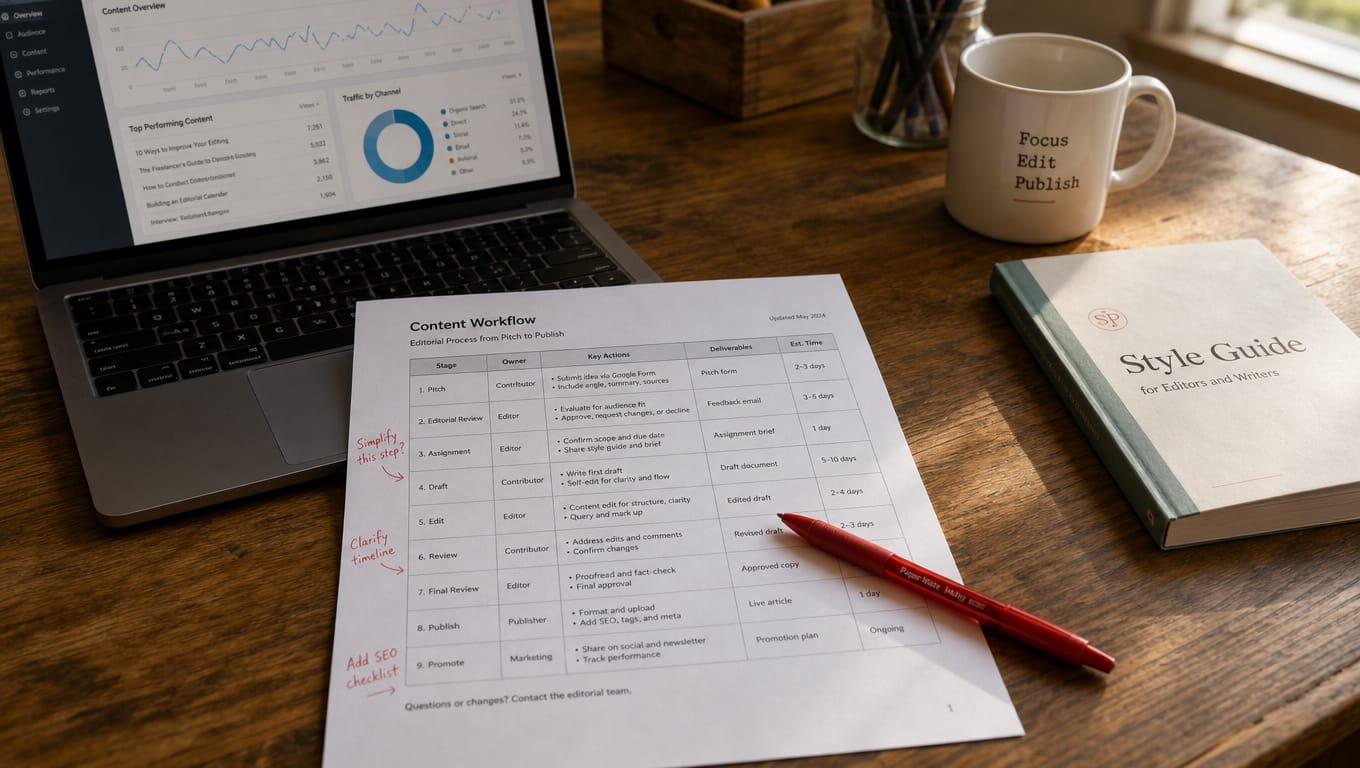
Before auditing your agency, it helps to understand what a well-run AI-assisted workflow looks like, so you can identify what's missing in yours.
| Task | AI Involvement | Human Accountability |
|---|---|---|
| Keyword research and clustering | AI tools assist | Strategist reviews and prioritizes |
| Initial content draft | AI generates | Editor rewrites with brand voice and market specifics |
| Performance analytics | AI surfaces patterns | Analyst interprets and makes recommendations |
| Final published copy | Not appropriate | Human authors and owns |
| Brand positioning and messaging | Not appropriate | Strategist develops from client research |
| Strategy recommendations | Not appropriate | Human produces with client context |
A transparent agency can hand you this kind of breakdown without being asked. They have a stated AI disclosure policy. They can tell you which tools they use, what the human review step looks like, and where AI doesn't touch the work. That transparency isn't a bonus feature. It's the baseline for any agency using artificial intelligence in client work.
The distinction worth holding onto: a tool that helps a strategist work faster is not the same as a tool that replaces the strategist. The table above shows where AI genuinely accelerates work without degrading quality, and where human judgment has no substitute. Agencies that blur that line are misrepresenting what you bought.
Since the point of this article is that any agency worth hiring should answer the marketing agency AI disclosure question directly, here's ours.
We use AI tools for keyword research, competitor analysis, content outlining, and first-draft generation on certain content types. Specifically, we use RankNest, our own SEO platform, for keyword research and internal link mapping, and Claude or ChatGPT for draft scaffolding on blog posts and ad copy variants.
What we don't do is run stock models on client work. We build custom AI models tuned to each client's business, trained on their services, their market, their voice, and the objections their sales team actually hears. Where a client's own systems matter, we pull their APIs into tools we built in house, so the model is working from that client's real data instead of generic assumptions. A stock chatbot with a clever prompt is not the same thing, and it doesn't produce the same work. The same logic shows up in our take on custom website vs Wix and Squarespace, where the right choice depends on how much the business needs control, speed, and room to grow.
What happens before anything ships: a strategist reviews every piece against the client brief, rewrites for brand voice, adds market-specific context, and checks factual claims. Nothing goes out as raw AI output.
What AI does not touch: client strategy, discovery conversations, positioning work, audience research, local market analysis, and final copy decisions. Those require someone who actually knows your business, your competitors, and your customers. AI tools don't know any of those things. They've never talked to your sales team. They don't know why your best customers found you or what objection kills deals in your market. That context only comes from actual human engagement, and it's what separates content that converts from content that fills a publishing calendar. If you're comparing agency promises against real deliverables, our guide to what a small business website includes at each price shows how much of that work should be spelled out before you sign.
This is covered when we onboard a client. If you ever want to see the process for your account specifically, ask. The answer should always be specific, not a policy statement.
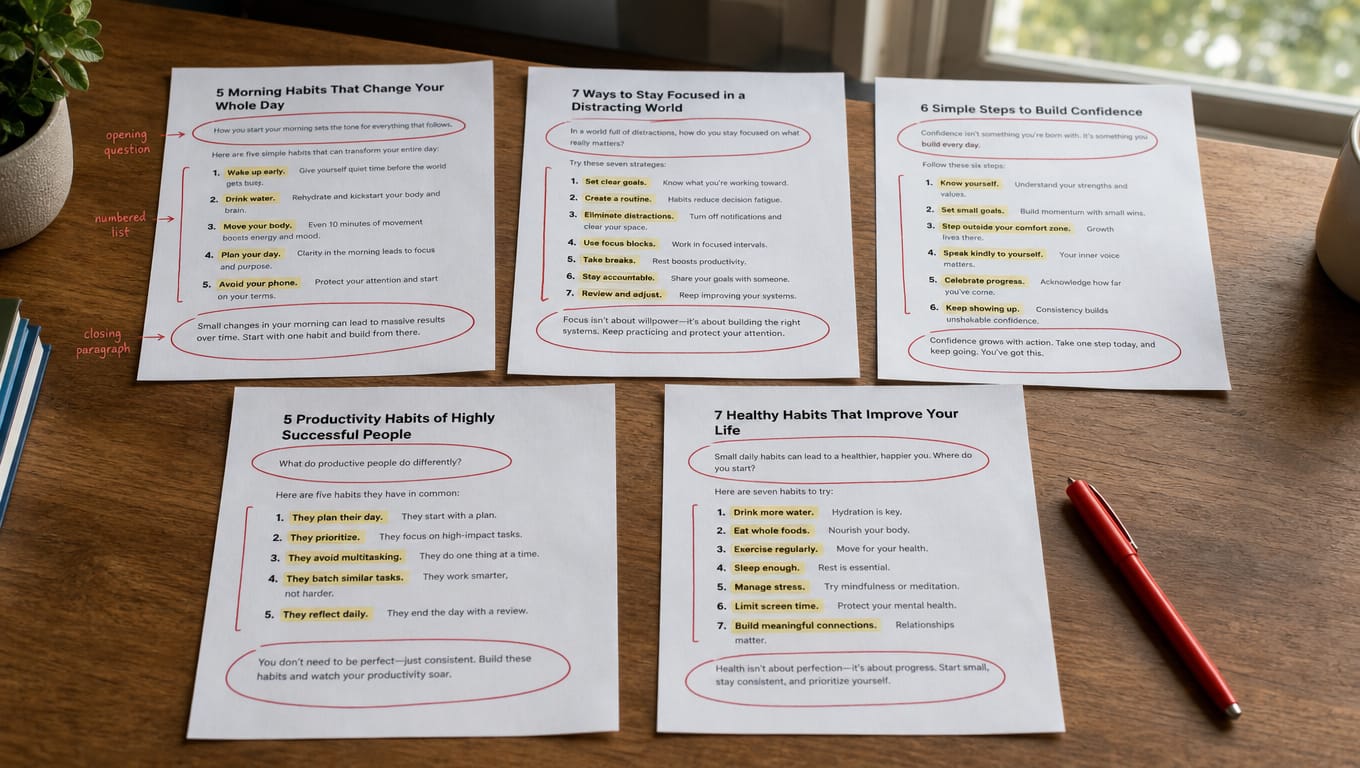
These are observable. Check them against what you already have.
1. Content is polished but contains no original insight. The writing is clean, the structure is logical, and there's nothing you couldn't have found by reading three generic articles on the same topic. No competitor-specific observations, no market commentary, nothing that suggests the writer knows your industry. Automated marketing content tends to produce exactly this: technically complete, strategically hollow.
2. Your last five blog posts follow the same structural template. Same opening gambit (often a question), same transition to a numbered list, same closing call to action phrased almost identically. Structural consistency at this level is a workflow tell. It reflects what the AI writing tool defaults to, not what a skilled writer chooses. A human with real editorial judgment varies structure based on the content and the reader's stage of awareness. If you want a real example of a project writeup that uses structure without sounding templated, see our guide to realistic website build timelines.
3. Statistics appear with no sources. AI models generate plausible-sounding figures with no citations. If your content includes data points and you can't find the original source with a quick search, that's a flag worth raising. Invented statistics are a real liability if your content makes claims your clients can look up.
4. Local or industry references feel tacked on. The content mentions your city or vertical, but only in ways that pass a keyword check, not in ways that show actual knowledge of your market. A plumber in Jacksonville and a plumber in Seattle get essentially the same blog post with the location name swapped. If your content could have been written for any competitor in your market without changing a single substantive sentence, it was.
5. AI phrase patterns appear consistently. Learn to detect AI-generated content by spotting these: "in today's fast-paced [industry]," "look no further," "are you struggling with," "navigating the complexities of," and heavy em-dash usage mid-sentence. These are large language model defaults. One instance might be coincidence. A pattern across deliverables is not.
6. Reports are data-dense and insight-light. Metrics show up: rankings, traffic, clicks. But there's no explanation of why something moved or what the agency is doing differently next month because of it. A report that just restates the dashboard is automated marketing content in spreadsheet form. If you're not certain what belongs in there, our breakdown of what an SEO agency actually does sets the baseline.
7. Ad copy variations are structurally identical. If your Google or Meta ad variants are the same sentence structure with one or two word swaps, that's a tool generating variants, not a creative test. Real testing means a different angle and a different hook, not a synonym. Two ads that differ only in a single adjective won't teach you anything about what your audience actually responds to.
8. Volume increased, communication decreased. More content, fewer conversations. If your agency is producing more but you're hearing less from them strategically, that ratio reflects AI's ability to generate volume at reduced labor cost, not deeper investment in your account.
9. No one can explain why a deliverable was made the way it was. Ask your account manager: "What was the strategic reason behind the angle we took in this blog post?" A real answer names the keyword intent, the audience stage, the competitor gap it addresses. Vague responses aren't answers. And an account manager who can't answer that question in two minutes probably wasn't involved in the decision.
Generic warning signs only go so far. Here's what to watch for based on what you actually bought.
Your local content mentions your city but not your neighborhood, not nearby landmarks, nothing that reflects real knowledge of your market. Google Business Profile posts are template-generic with no seasonal relevance, no connection to local events, nothing a community member would recognize.
Local SEO reporting covers keyword rankings but never addresses review response strategy, citation consistency, or local link-building activity. If your agency manages your local SEO and has never once mentioned your Google Business Profile in a strategic context, ask why.
Product descriptions follow an identical sentence structure across all SKUs regardless of category or price point. Blog content publishes frequently but earns no inbound links and shows high bounce rates. That's automated marketing content volume with no resonance in the market, and it's the same pattern behind traffic that never turns into leads.
Email sequences read as generic nurture flows. The same message goes to a first-time visitor and someone who abandoned a cart three times. If there's no purchase-behavior logic in the sequencing, there's no human thinking in the segmentation.
Meta ad copy uses recognizable AI writing tool phrase patterns consistently. Caption voice is inconsistent across posts, or consistently formal in a channel where conversational tone drives engagement. Creative variations are minimal: same visual concept, minor word swaps, no genuine angle differentiation. Social platforms reward specificity and personality. AI defaults to neither.
Website copy is professionally written but contains no evidence of industry-specific research. It could have been produced for any company in your category. It usually skips the fundamentals a small business website actually needs too, because those require knowing the business. SEO content targets high-volume generic terms rather than the specific, intent-rich queries your actual buyers use.
Most telling: none of the content addresses the objections your sales team hears in real conversations. If your agency has never talked to your sales team, that's a process problem before it's an AI problem. Agencies over-relying on AI skip that step more often because the tool doesn't require it. The content sounds credible in isolation and fails completely in context.
Use your last 30 days of deliverables and interactions. Three responses per item: Yes, No, or Unsure. An "Unsure" is itself a finding. It means you don't have enough visibility into your agency's AI disclosure practices, which is a problem regardless of what's actually happening.
Deliverables Evidence
Account Visibility Evidence
Agency Behavior Evidence
Score Interpretation
Most business owners avoid this conversation because they don't want to sound paranoid or uninformed. A good agency welcomes questions about its AI disclosure policy. Evasiveness is your finding.
These work in any check-in. They're process questions, not accusations.
What a good answer sounds like: Specific steps, named people, a described review process. The answer should take more than 10 seconds.
What a deflection sounds like: "Our team follows best practices for content creation." No names, no steps.
What a good answer sounds like: Access is granted. A tool list is provided without hesitation. The strategic decision comes with context: the audience stage, the keyword intent, the competitor gap it was meant to address.
What a deflection sounds like: "We protect our proprietary processes." "We've been very focused on driving results for you."
A strong answer to the last question isn't "of course it does." It's a specific explanation of what quality controls exist and what happens when something doesn't meet the standard. An agency with a real review process can answer that in plain language. An agency running raw AI output through light editing cannot.

The marketing agency accountability test is simple: has a qualified human being reviewed, customized, and taken responsibility for every client-facing deliverable?
AI for keyword research and performance analytics is fine. That's using a tool to process data faster than a human would. The strategist still has to make sense of the data and decide what to do with it.
AI as the final author of your brand content with no meaningful human revision is not fine. That's billing for expertise you didn't receive. If you're not sure whether your retainer is even in a normal range to begin with, our breakdown of what SEO should cost in 2026 gives you the benchmarks.
Some agencies are explicitly AI-native and build their entire workflow around AI infrastructure. That model can work, and it can be done with complete transparency. An AI marketing agency that tells you exactly what the workflow looks like and who reviews the output before it ships is a legitimate choice. What's not legitimate is an agency running that same model while billing as if every deliverable reflects senior human craft. The agency AI ethics question isn't about the technology. It's about what was represented and what was delivered.
The AI transparency standard every agency should meet, regardless of how much AI they use:
These standards aren't extraordinary. They're what you'd expect from any professional service relationship. The fact that so many agencies can't meet them on the AI question is the actual problem.
The questions about process, intellectual property, and what's actually included in deliverables overlap significantly with broader agency selection. Our guide to hiring a web design agency covers that territory in more detail.
If the audit above surfaced more "Unsure" responses than you expected, that's worth acting on. Visibility gaps into your agency's AI use policy don't resolve themselves, and agencies rarely volunteer transparency they haven't been asked for.
Grindstone offers a free review covering both website design and SEO. No commitment, just an honest look at what your current setup is delivering and where the gaps are. If what you have is working, we'll tell you that too.
If you're benchmarking spend at the same time, our guide to what a website actually costs to build lays out real 2026 numbers.
Is AI-generated marketing content bad for SEO?
AI-generated content isn't automatically penalized by Google. As Google has stated directly, what matters is whether content is helpful and serves users well, not the tools used to produce it. In practice, low-quality, unedited AI content frequently performs poorly because it fails to demonstrate the experience, expertise, and authoritativeness Google's quality systems evaluate. Well-edited, human-reviewed content that uses AI at the research or draft stage is a different matter entirely. If your pages aren't appearing in search at all, that's usually a separate technical problem: see why a site fails to show up on Google.
Can AI detection tools tell me definitively if my agency is using AI?
No, and you shouldn't rely on them alone. As Originality.ai's own research documents, these tools produce false positives on human-written content and false negatives on well-edited AI output. Use them as one data point, not a verdict. The more reliable signal is whether your content demonstrates genuine expertise, specific market knowledge, and original strategic reasoning. No detection tool can measure any of that.
Should I ask my marketing agency directly if they use AI tools?
Yes, and how they answer tells you as much as what they answer. Frame it as a process inquiry: "Can you walk me through your team's approach to AI tools in your workflow?" A confident, specific response signals a solid AI disclosure policy. A defensive or vague response is a warning sign regardless of what's actually happening in their workflow.
What's the difference between an AI-native agency and a traditional agency that uses AI tools?
An AI-native agency has built its core workflow around AI infrastructure from the ground up. A traditional agency has adopted AI writing tools into an existing human-led process. For most clients, the category matters less than the marketing agency accountability question: are human experts directing the work, reviewing the output, and taking responsibility for results? Either model can deliver, or fail, depending on that answer.
What if my agency confirms they use AI? Should I leave?
Not necessarily. If they can tell you specifically what AI handles, what the human review step looks like, and where AI doesn't touch the work, that's the marketing agency AI transparency you're looking for. What warrants a harder conversation is if they've been using AI without disclosing it, or if their explanation of human oversight is vague given the volume of work they're producing.
How much of my marketing should involve AI versus manual work?
There's no useful ratio. The relevant distinction is by task type. Data analysis, keyword research, and initial drafts are areas where AI adds efficiency with low quality risk when properly reviewed. Brand voice, strategic positioning, and creative direction require human judgment at every stage. Any task where the output is the deliverable requires human accountability at review, regardless of the tools involved. Agency AI ethics come down to that single question: is a named, accountable human standing behind this work?
Discover more insights from our latest articles


